Sample information |
|
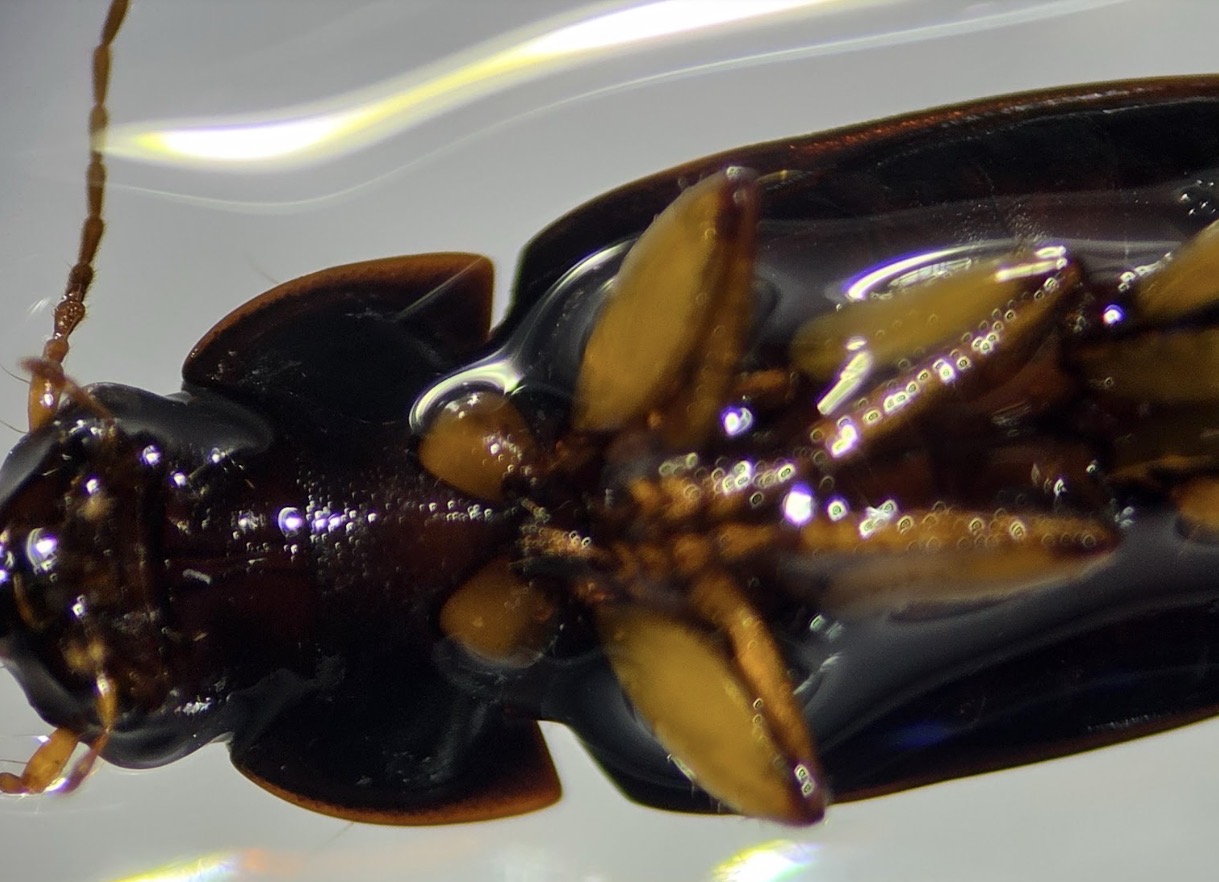
| Picture |
|
|---|---|
| Location | Approximate location: 38.94, -77.09 |
| Collection date | 09/10/2026 |
| Captive / Cultivated? | Wild-caught |
| Group | Edmund Burke School |
| Observations | Wing number: Four Wing size: One pair small and one pair large Mouth shape: external mandible for chewing For leg shape and size: not modified Wing shape: Broad Hind leg shape and size: Not modified Wing type: Membranous (inside) Hard and Opaque (outside) Antenna number and shape: Two (elbowed) Wing venation: Unclear Body regions Three Number of legs: Six Body shape: Broad and flat Eyes: Unclear Color: Dark brown Caught in the summer, 70 degrees F, in an urban environment, in a basement on a shelf in between legos |
| Putative identification | Arthropoda Insecta Coleoptera Carabidae Harpalus Harpalus pensylvanicus |
Methods |
|
| Extraction kit | DNeasy (Qiagen) |
| DNA extraction location | Whole arthropod |
| Single or Duplex PCR | Single Reaction |
| Gel electrophoresis system | MiniOne |
| Buffer | TBE |
| DNA stain | GelGreen |
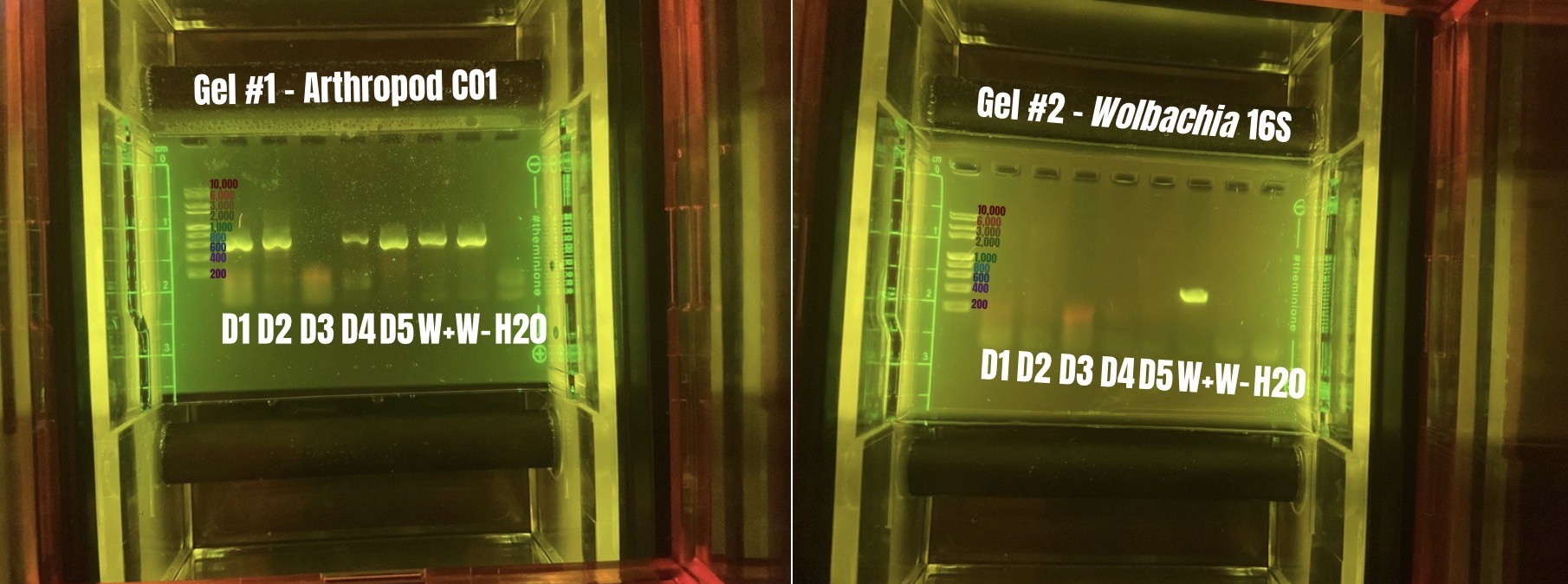
| Gel images |
|
| Protocol notes | DNA extraction: The arthropod was very difficult to crush up due to its hard exoskeleton, no mistakes were made in the dna extraction process PCR: no mistakes Gel electrophoresis, Arthropod CO1: The lanes were ordered by Ladder, D1,D2,D3,D4,D5,W+,W-, and H2O Controls worked, they served to confirm that our Electrophoresis machines were working and to confirm that our arthropods DNA had been correctly amplified
Gel electrophoresis, Wolbachia: The lanes were ordered by Ladder, D1,D2,D3,D4,D5,W+,W-, and H2O Controls worked, they served to confirm that our Eelectrophoresis machines were working, and the W- and water confirming that there was no contamination and the W+ confirmed we amplified the Wolbachia DNA correctly
|
Results |
|
| Wolbachia presence | No |
| Confidence level | High |
| Explanation of confidence level | The W+ and W- controls helped us confirm this since in both tests they confirmed that we had run it correctly and it wasn’t an issue with the PCR or Electrophoresis labs since the controls all worked as intended, leading to our high confidence in our results. The W+ band showed up for the Arthopod CO1 gel so we know that the DNA was correctly amplified and the PCR was not the issue |
| Wolbachia 16S sequence | |
| Arthropod COI sequence | Download FASTA
Download AB1
|
| Summary | The Harpalus pensylvanicus was found to be negative for Wolbachia. |
 Curinus Coeruleus
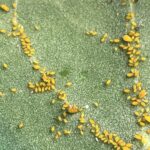
 Aphid
 (no title)
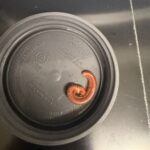 Rusty Millipede
 A-2 Arachnida