Sample information |
|
| Picture |

|
|---|---|
| Location | Approximate location: 38.82, -77.17 |
| Collection date | 03/11/2025 |
| Captive / Cultivated? | Wild-caught |
| Group | Thomas Jefferson High School for Science and Technology |
| Observations | Found mating with other water striders as being collected in shallow stream |
| Putative identification | Arthropoda Insecta Hemiptera |
Methods |
|
| Extraction kit | DNeasy (Qiagen) blood and tissue kit |
| DNA extraction location | Partial abdomen |
| Single or Duplex PCR | Single Reaction |
| Gel electrophoresis system | MiniPCR |
| Buffer | TBE |
| DNA stain | SYBR Safe |
| Gel images |
|
| Protocol notes | |
Results |
|
| Wolbachia presence | No |
| Confidence level | Low |
| Explanation of confidence level |
There was no clear band for the CO1 test which indicates that this sample did not test positive as an arthropod, indicating error in DNA extraction considering both the positive and negative controls had CO1 bands (meaning that error in gel electrophoresis is less likely). The 16S test (for Wolbachia presence) had been jostled during the gel loading process (as the loading dye was not visible once the gel had been run), which is why the ladder is not visible. However, the positive and negative controls appear to have the expected result, suggesting that this jostling error had occurred during loading one of the A4-A6 samples. This means that the lack of Wolbachia band in the A5 sample could be due to no Wolbachia presence or this error. The gel to its left (with A1-A3 samples) is added for comparison as it had run for the same duration. |
| Wolbachia 16S sequence | |
| Arthropod COI sequence |
|
| Summary | The Hemiptera was found to be negative for Wolbachia. |


 Millipede
 Brown Widow
 (no title)
 Texas Carpenter Ant
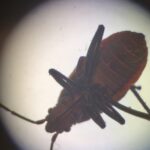 Boxelder Bug (Hemiptera)