Sample information |
|
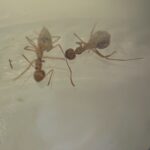
| Picture |
|
|---|---|
| Location | Approximate location: 44.93, -93.17 |
| Collection date | 09/17/2025 |
| Captive / Cultivated? | Wild-caught |
| Group | St. Paul Academy and Summit School |
| Observations | The ant was slightly smaller than a grain of rice. It was black colored and very active. It was collected after a classmate destroyed its mound, and it scurried onto the sidewalk |
| Putative identification | Arthropoda Insecta Hymenoptera Formicidae Tetramorium Tetramorium caespitum |
Methods |
|
| Extraction kit | DNeasy (Qiagen) blood and tissue kit |
| DNA extraction location | Whole arthropod |
| Single or Duplex PCR | Single Reaction |
| Gel electrophoresis system | MiniPCR |
| Buffer | TBE |
| DNA stain | SeeGreen |
| Gel images |
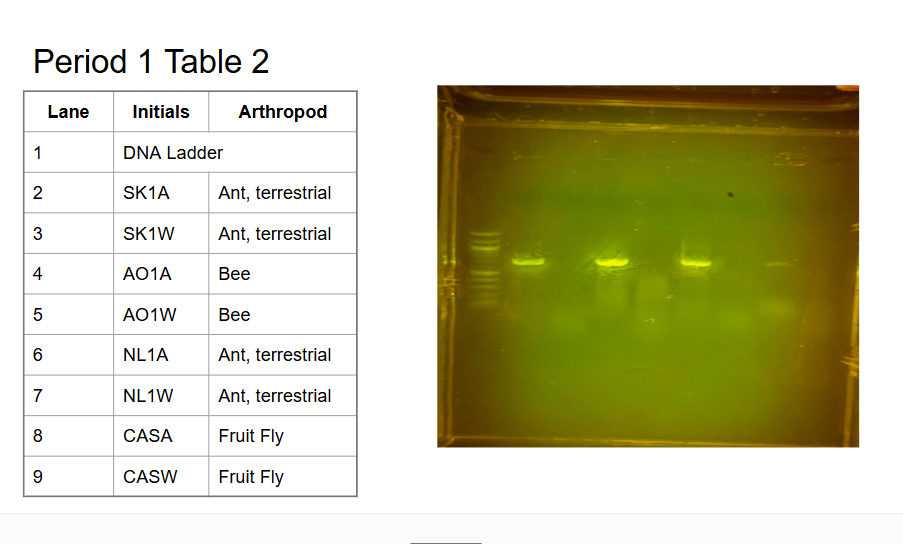
|
| Protocol notes | The lanes that had the data for my ant were SK1A(to show that there was dna and it was an arthropod) in the second lane from left, and SK1W(the actual marker of Wolbachia) in the third lane from left (2 and 3) |
Results |
|
| Wolbachia presence | No |
| Confidence level | High |
| Explanation of confidence level | |
| Wolbachia 16S sequence | |
| Arthropod COI sequence | Download AB1
|
| Summary | The Tetramorium caespitum was found to be negative for Wolbachia. |
 Millipede
 Brown Widow
 (no title)
 Texas Carpenter Ant
 Boxelder Bug (Hemiptera)