Sample information |
|
| Picture |
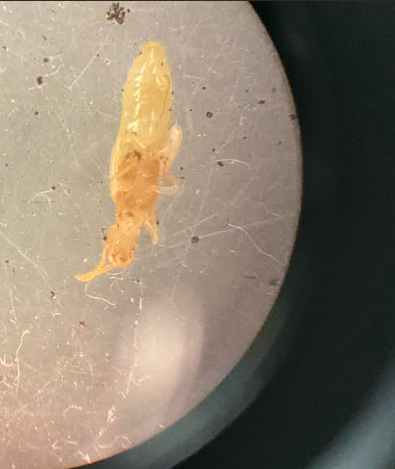
|
|---|---|
| Location | No map location data available. |
| Collection date | 04/20/2026 |
| Captive / Cultivated? | Wild-caught |
| Group | Thomas Jefferson High School for Science and Technology |
| Observations | Arthropod found in decaying wood stump in a grassy field. The termite is a nymph, slightly translucent beige color, about 1/2 cm in length. Collected during clear spring morning weather, ~23 degrees Celsius. |
| Putative identification | Arthropoda Insecta Blattodea |
Methods |
|
| Extraction kit | DNeasy (Qiagen) blood and tissue kit |
| DNA extraction location | Whole arthropod |
| Single or Duplex PCR | Single Reaction |
| Gel electrophoresis system | MiniPCR |
| Buffer | 1X TBE |
| DNA stain | SYBR Safe |
| Gel images |
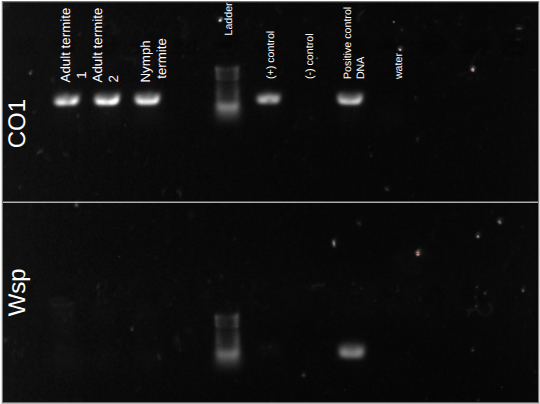
|
| Protocol notes | This sample is the “Nymph termite” row in the gel. DNA Extraction: I used a pestle and grains of sand to crush the arthropod. The entire insect was used as it was less than 2mm. Gel Electrophoresis Lanes: 1- blank 2- termite 151 3- termite 152 (this specimen) 4- termite 153 5- blank 6- ladder 7- positive control Drosophila 8- negative control Drosophila 9- positive control DNA 10- water 11-13- blank Analysis: The bands for the termites were all the same length, which confirms that they are the same species. However, the negative control Drosophila did not work as there are two bands where there should be none and the positive control DNA did not work as there are no bands where there should be one. Our confidence level is medium all of our negative controls worked, which prevent false positives. However, our positive control DNA for Wsp did not work, which means that it could possibly be a false negative. This means that our samples might potentially have Wolbachia but it did not show up in the gel. |
Results |
|
| Wolbachia presence | No |
| Confidence level | Medium |
| Explanation of confidence level | Our negative controls all worked as intended. Our positive control DNA worked as intended. Our positive control from Drosophila did not exhibit any bands, which was not expected, leading to lower confidence. More info in protocol notes. |
| Wolbachia 16S sequence | |
| Arthropod COI sequence | Download AB1
|
| Summary | The Blattodea was found to be negative for Wolbachia. |
 (no title)
 Yellowjacket Wasp
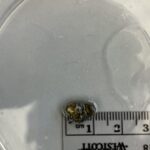 Pillbug
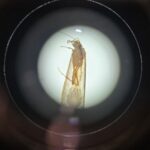 Umpachene Falls Caddisfly
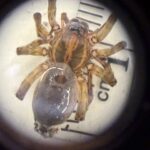 Wolf Spider