Sample information |
|
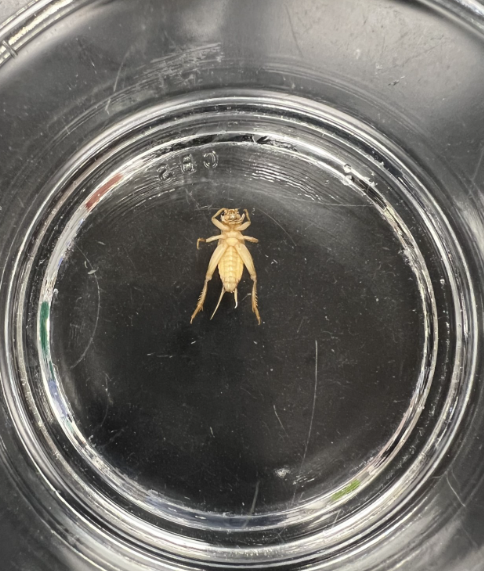
| Picture |
|
|---|---|
| Location | Approximate location: 26.73, -80.09 |
| Collection date | 09/07/2023 |
| Captive / Cultivated? | Captive / Cultivated |
| Group | Palm Beach Atlantic University |
| Observations | I collected only one cricket from a container containing many other crickets. The crickets were living in an environment with mulch/straw. I collected this cricket from PetSmart in West Palm Beach, FL 33401 on September 7, 2023 at 3:00pm. |
| Putative identification | Arthropoda Insecta Orthoptera Gryllidae |
Methods |
|
| Extraction kit | DNeasy (Qiagen) |
| DNA extraction location | Partial abdomen |
| Single or Duplex PCR | Single Reaction |
| Gel electrophoresis system | Standard electrophoresis system |
| Buffer | TAE |
| DNA stain | GelGreen |
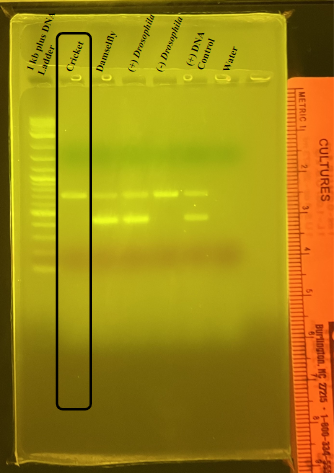
| Gel images |
|
| Protocol notes | DNA Extraction: I removed the exoskeleton and only dissected a piece of the lower abdomen out. I made sure to crush the cricket abdomen really well. |
Results |
|
| Wolbachia presence | No |
| Confidence level | High |
| Explanation of confidence level | All of my controls worked as expected. I did not have any problems with the protocol. The bands appeared as they should have; therefore, I am confident my arthropod is not infected with Wolbachia. |
| Wolbachia 16S sequence | |
| Arthropod COI sequence |
|
| Summary | The Gryllidae was found to be negative for Wolbachia. |
 Millipede
 Brown Widow
 (no title)
 Texas Carpenter Ant
 Boxelder Bug (Hemiptera)