Sample information |
|
| Picture |
|
|---|---|
| Location | Approximate location: 19.70, -155.08 |
| Collection date | 11/13/2025 |
| Captive / Cultivated? | Wild-caught |
| Group | Hawaii Community College |
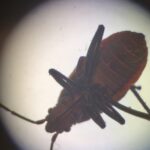
| Observations | A clover mite (Bryobia praetiosa) collected from the compost area at Hawai‘i Community College tested positive for Wolbachia. A faint 16S rRNA band was visible on the agarose gel, confirming the presence of the bacterium. |
| Putative identification | Arthropoda Arachnida |
Methods |
|
| Extraction kit | none |
| DNA extraction location | Whole arthropod |
| Single or Duplex PCR | Single Reaction |
| Gel electrophoresis system | Standard electrophoresis system |
| Buffer | lysis |
| DNA stain | Cyber Stain |
| Gel images |
|
| Protocol notes | DNA was extracted from a clover mite (Bryobia praetiosa) using the standard Wolbachia Project lysis, precipitation, and elution procedure. The specimen was rinsed with water, transferred into a labeled microcentrifuge tube, and ground in Cell Lysis Buffer with a sterile pestle. The tube was heated, vortexed, and centrifuged to pellet debris. The supernatant was moved into a new tube containing cold isopropanol to precipitate DNA, followed by centrifugation and a 70 percent ethanol wash. The DNA pellet was air-dried and resuspended in DNA Elution Buffer. A single CO1 PCR and a single Wolbachia 16S rRNA PCR were prepared for the clover mite sample. PCR products were run on a 2 percent agarose gel cast with SYBR Safe dye in TBE buffer. A DNA ladder was included for size comparison. After electrophoresis, the gel was viewed under UV light. The clover mite produced a faint but visible band in the Wolbachia 16S lane, confirming infection. |
Results |
|
| Wolbachia presence | Yes |
| Confidence level | Medium |
| Explanation of confidence level | Confidence is rated as medium because the Wolbachia band was faint and the DNA yield was low. Limited laboratory experience also adds some uncertainty, but the band was still visible and supports a positive result. |
| Wolbachia 16S sequence | |
| Arthropod COI sequence |
|
| Summary | The Arachnida was found to be postive for Wolbachia. |
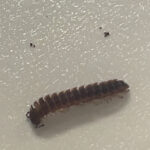 Millipede
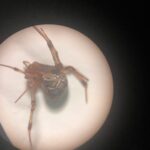 Brown Widow
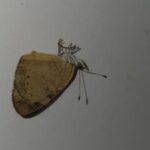 (no title)
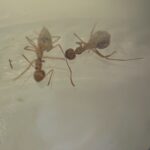 Texas Carpenter Ant
 Boxelder Bug (Hemiptera)