Sample information |
|
| Picture |
|
|---|---|
| Location | Approximate location: 38.98, -77.00 |
| Collection date | 09/15/2022 |
| Captive / Cultivated? | Wild-caught |
| Group | Edmund Burke School |
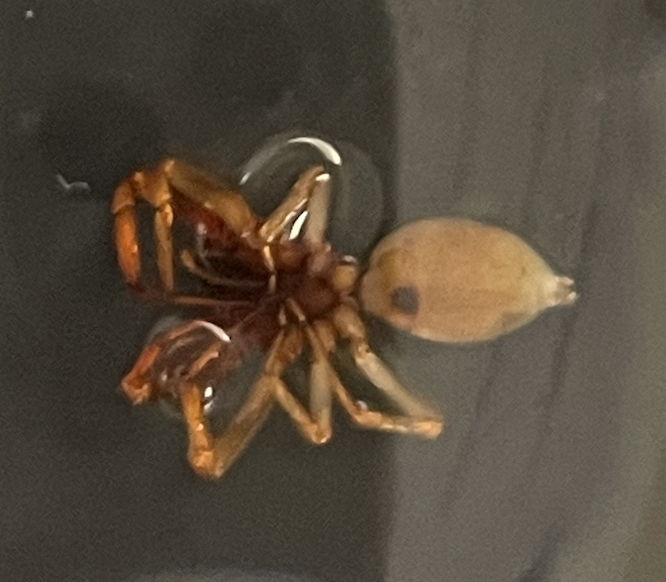
| Observations | I found this Spider in my house near Washington, D.C. (which is kept at a temperature of approximately 72 degrees F). I collected it in the morning, around 7:30 AM, and the outdoor temperature that day was in the 70s (F). The spider is small/medium sized with red/brown coloring, long legs, and bulging circular abdomen. I later found it to be a pregnant female. It had low energy and did not move a lot. It also had a tendency to hide in dark areas and play dead when frightened. |
| Putative identification | Arthropoda Arachnida Araneae |
Methods |
|
| Extraction kit | DNeasy (Qiagen) |
| DNA extraction location | Abdomen |
| Single or Duplex PCR | Single Reaction |
| Gel electrophoresis system | MiniOne |
| Buffer | TBE |
| DNA stain | GelGreen |
| Gel images |
|
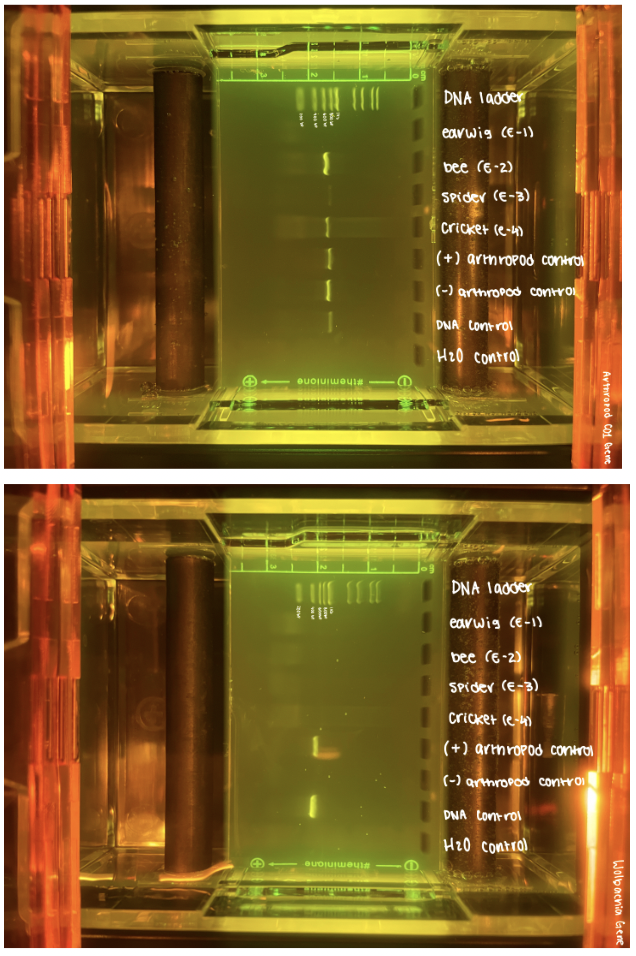
| Protocol notes | DNA extraction: I made sure to crush the arthropod really well. I dissected the abdomen out, and did not include the exoskeleton. Gel electrophoresis lanes for CO1 arthropod PCR: 1- 10kb DNA ladder. 2-The second well is my earwig (E-1) 3-The third well is my bee (E-2) 4- The fourth well is my spider (E-3) 5- The fifth well is my cricket (E-4) 6- The sixth well is my (+) arthropod control 7- The seventh well is my (-) arthropod control 8- The eight well is my DNA control 9- The ninth well is my H20 control Analysis: My controls worked, but sample E-1 did not have a band. There could have been a problem with the primer sticking. Gel electrophoresis lanes for Wolbachia PCR: 1- 10kb DNA ladder. 2-The second well is my earwig (E-1) 3-The third well is my bee (E-2) 4- The fourth well is my spider (E-3) 5- The fifth well is my cricket (E-4) 6- The sixth well is my (+) arthropod control 7- The seventh well is my (-) arthropod control 8- The eight well is my DNA control 9- The ninth well is my H20 control Analysis: My controls worked, so I am confident that there was no contamination.
|
Results |
|
| Wolbachia presence | No |
| Confidence level | High |
| Explanation of confidence level | All of my controls worked as expected. I did not have any problems with the protocol, and I was not surprised by any bands on the gel. Therefore, I am confident that my arthropod is not infected with Wolbachia. |
| Wolbachia 16S sequence | |
| Arthropod COI sequence | Download AB1
|
| Summary | The Araneae was found to be negative for Wolbachia. |
 Millipede
 Brown Widow
 (no title)
 Texas Carpenter Ant
 Boxelder Bug (Hemiptera)